CCA Battery Tester Explained: A UK Buyer's Guide
Short answer: a CCA battery tester checks whether a battery can still deliver its rated cold cranking amps — the burst of current needed to start an engine in the cold — rather than just showing a healthy voltage. For anyone buying and reselling vehicles, it is the quickest way to tell a battery that needs a recharge from one that needs replacing before the car goes on the forecourt.
A part-exchange or auction car that has just been jump-started will start again on the button, which is exactly what makes it dangerous stock. The surface charge hides a low state of health, and the fault only reappears after the car has stood on the pitch for a fortnight — by which time it is a warranty argument, not a buying decision.
What should you know about a CCA battery tester at a glance?
- CCA measures cranking current at low temperature; a CCA tester compares measured CCA to the battery's rated figure to give a state of health.
- It reveals a weak battery that resting voltage — or a successful jump-start — would hide.
- You must enter the correct rating standard (CCA, DIN, EN or SAE) and the correct battery type for a reliable reading.
- For a trader, a dated result supports an honest hand-over snapshot without over-promising future performance.
What is a CCA battery tester, and what does CCA mean?
CCA stands for cold cranking amps: the current a fully charged battery can deliver at −18 C for 30 seconds while staying above a usable voltage. It is the headline number on most starter batteries because it reflects the job that matters — turning over a cold engine. A CCA battery tester measures the battery's present cranking ability and expresses it as a percentage of that rated figure, so a 640 CCA battery reading 460 CCA is clearly on the way down.
How does a CCA battery tester work?
Modern units use conductance testing: a small signal is passed through the battery and the response is converted into a CCA value and a state-of-health percentage within seconds. There is no heavy load, no heat and no need to remove the battery, which makes it practical to check a whole row of stock quickly.
Rating standards: CCA, DIN, EN and SAE
The same battery can be rated under different standards, and the numbers are not interchangeable. A reliable tester lets you select CCA (SAE), DIN, EN or IEC and enter the figure from the label. Enter the wrong standard and the SOH percentage is meaningless — a frequent cause of a good battery being condemned or a tired one being passed.
Why does a jump-start hide the truth?
Because starting the car proves only that the battery had enough charge for one crank, not that it has the capacity for a cold morning three weeks later. Voltage can look fine while the true cranking figure has collapsed. A CCA test measures capacity directly, so you find the weak battery at the point of purchase rather than after the sale.
Testing mixed stock: flooded, AGM and EFB
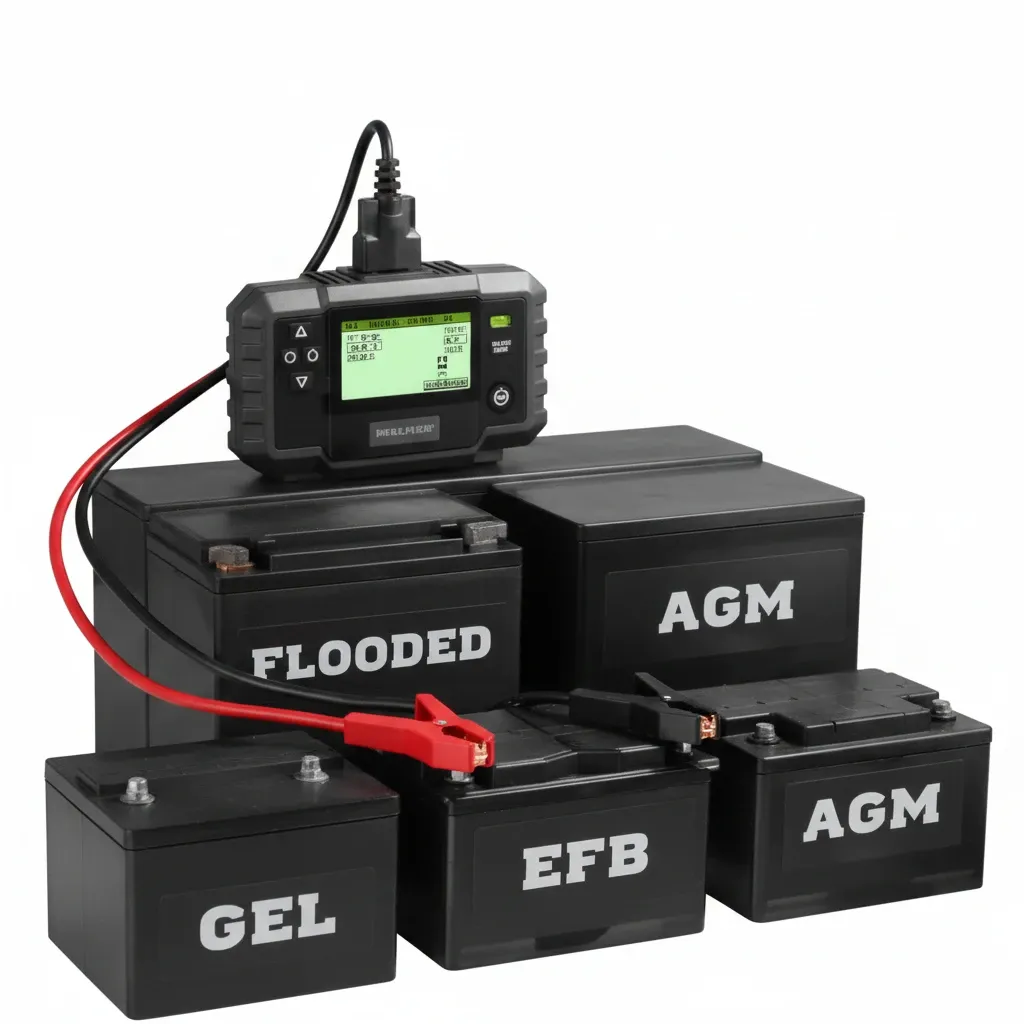
A used-car pitch rarely holds one battery type. Traditional flooded units sit next to AGM (flat-plate and spiral) and EFB batteries fitted to stop-start models, and each behaves differently under test. Select the correct type before testing every time; treating an AGM stop-start battery as standard flooded will skew the CCA reading and can trigger a false "replace" verdict on an expensive battery. For the full test procedure, see our how to test a car battery guide.
How to use CCA results when buying and selling
At the point of appraisal, a CCA and SOH reading tells you whether to negotiate on price, recharge and retest, or budget for a replacement before the car is retailed. It also lets you distinguish a battery that is merely flat from one that is genuinely spent, so you are not fitting new batteries you did not need. For a broader view of what a full inspection covers, our car battery load tester guide explains how load, cranking and charging checks fit together.
At hand-over, a printed snapshot of the battery's health on the day is a fair, transparent record. Present it as a measurement taken at that moment — useful evidence of due diligence — rather than a guarantee that the battery will never fail, which keeps the buyer's expectations realistic and protects you later.
Testing CCA with the BattCheck Pro Print
The BattCheck Pro Print gives a fast conductance-based CCA and state-of-health reading across a 100–2000 CCA range, with selectable rating standards and profiles for regular flooded, AGM flat-plate, AGM spiral, EFB and GEL batteries. It covers 12V and 24V systems, runs cranking and charging-system checks, and shows results on a 3.5-inch colour screen. Powered directly from the 8V–30V battery under test with 1.8 m leads and an integrated 57mm thermal printer, it hands you a dated snapshot for the buyer. It is £284.10 inc. VAT (£236.75 ex. VAT) with free UK next-day delivery, 30-day returns and a 12-month warranty with UK-based support.
Check CCA before a car reaches the forecourt
View the BattCheck Pro Print — £284.10Frequently asked questions
What does CCA mean on a car battery?
CCA is cold cranking amps: the current a fully charged battery can deliver at minus 18 degrees Celsius for 30 seconds while staying above a usable voltage. It reflects the battery's ability to start a cold engine, which is why it is the headline rating on most starter batteries.
Why does a jump-started car still need a CCA test?
Starting the car proves only that the battery had enough charge for one crank, not that it can cope with a cold morning weeks later. A CCA test measures the battery's real cranking capacity, revealing a weak battery that a successful jump-start would hide.
Do I need to select the battery type and rating standard?
Yes. Enter the correct rating standard (CCA, DIN, EN or SAE) and the correct battery type, because AGM, EFB and flooded batteries respond differently. Using the wrong setting skews the reading and can wrongly pass or condemn a battery.
Will charging a battery improve its CCA reading?
Only if the battery was simply discharged. Charging restores state of charge, but an aged or sulphated battery will still read low on CCA afterwards, because the test measures capacity, not just charge level.
Ready to equip your workshop with BattCheck?
Shop BattCheck Pro CCA Tester — £284.10 · Free UK Delivery